From Hatching to Harvest: A Season of New Life
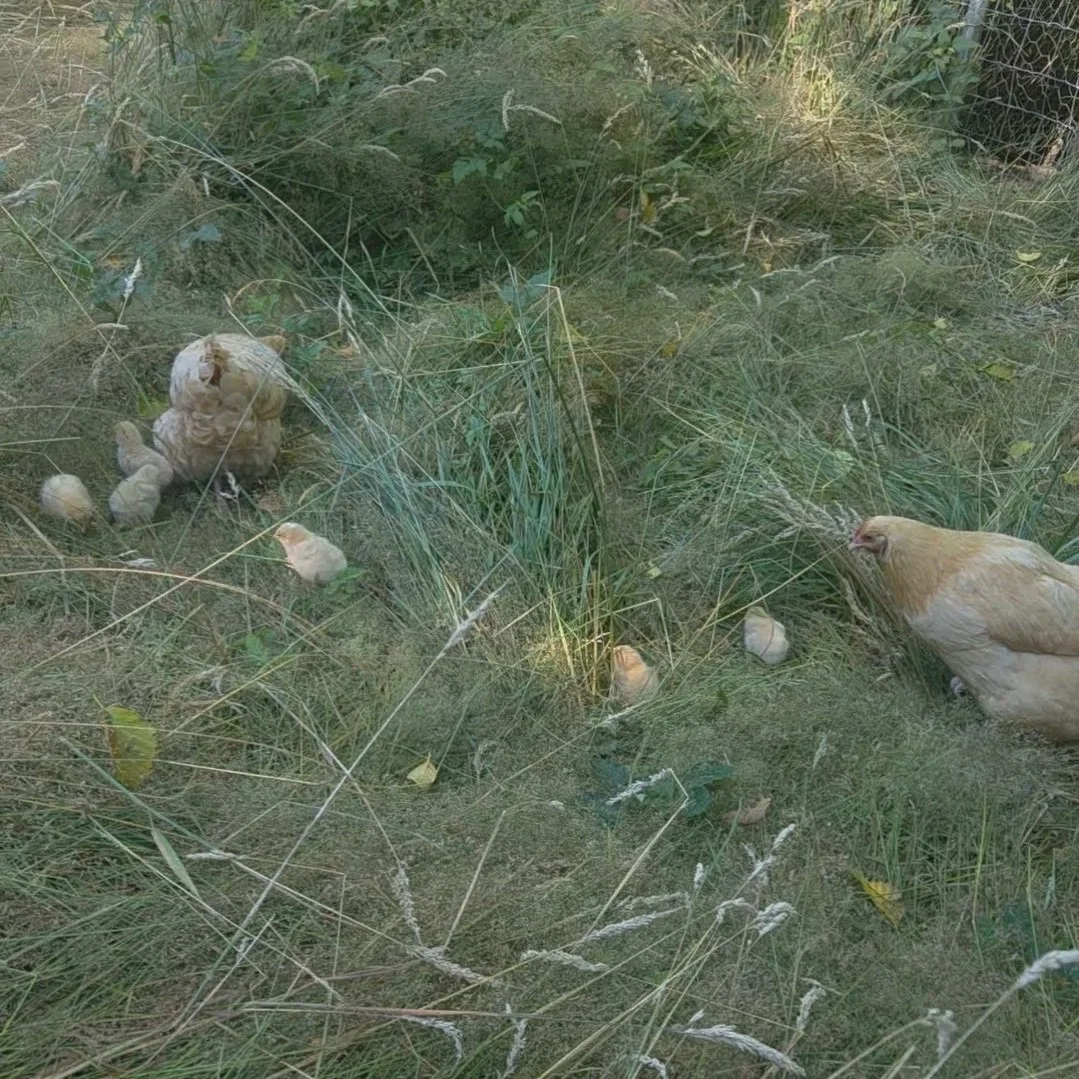
Day Old Chicks
Two of my orpington hens are co-parenting a group of 6 freshly hatched chicks.
The thing about farming is that the farm never really stays the same.
Every season brings something new: a new planting, a new project, a new animal, a new lesson learned. Sometimes that change is intentional, like expanding a garden bed or adding to the flock. Sometimes it is unexpected, like a fence that needs repairing or a problem that needs solving. But either way, the farm is always teaching us to adapt.
Here, we have always believed that the animals on our farm should have a purpose beyond simply producing something for us. The best farm systems are built on relationships—animals supporting the land, the land supporting the animals, and both supporting the people who care for them.
Another summer, another flock of ducklings
We love duck eggs. They are just so rich and delicious, and for a long time really felt like the community around us just didn’t get it. But once I started showing up with my duck eggs at the local farmers market, I found out just how much this community loves their duck eggs too. Sometimes it is simply about knowing the right people — and the people that know, know.
So, we added to our current flock of five with an additional ten for two important reasons.
First, our ducks have a job to do around our farm. We use them as slug control in the garden beds, as well as clover control in the beds with living mulch. Here, our ducks keep the endless march of forest slugs at bay, clip the clover short between seasons, allowing some of the stored nitrogen to be released, and we get the added bonus of eggs. Well, starting next year, the food garden will officially be twice as big as it is now. While the ducks do a fabulous job as is, we know that we need more security patrolling the tomato beds if we hope to win this battle.
Second, I cannot keep up with the community’s hunger for duck eggs while also keeping my husband’s own cravings for them at bay. Earlier this year, I was drowning in duck eggs to the point of making loaf after loaf of egg bread just so they wouldn’t go to waste. After one farmer’s market event, I had a waitlist of people wanting duck eggs.
These ducklings arrived the week of June 22, 2026, and will be ready to come out of their brooder around the beginning of August, or once their true feathers start to come in. Currently, our flock of adult ducks can often be found sleeping against the bars of the brooder, so it seems that flock integration should go rather smoothly.
Expanding the duck flock allows our farm to grow with demand, expand our diversity, and provide security in expanding the garden.
The meat chicks are growing up
Last year, I decided that I no longer wanted to rely on a commercial hatchery for my meat birds. Then, I decided to raise my own dual-purpose chickens that met specific requirements of mine for temperament and tendencies, that also doubled as a sustainable meat source. In March of this year, we hatched out our first 25 meat birds from chickens raised on our farm.
Officially speaking, these birds are no longer cute little fluffy chicks. They have officially entered their teenage era, where the roosters make feeble, commical attempts to crow.
Every day, they look a little more like chickens. Soon, they will start filling out their broad bodies, and will be ready for processing by the end of summer, filling our freezers in time for the next batch to hatch and take their places.
This cycle allows us to hatch and process our own meat birds while maintaining control over the entire process. Our goal is not simply to raise meat birds—it is to develop a flock that can reproduce here on our farm, allowing us to rely less on outside hatcheries and build a more resilient food system.
New chicks in the production pen
Meanwhile, the next generation of our laying flock has already arrived. Watching chicks hatch never gets old. After days of waiting and hoping, those tiny cracks in the shell become new life in a matter of hours.
While we also get the benefit of selecting the genetics we want in our flock, we are continuing to work toward building a sustainable production flock that will feed our family, and eventually our community, for years to come. While there are still processes to sort out, we are eager to be able to sell meat birds hatched, raised, and processed on our farm to our local community, and have already received requests to be notified when our meat bird production goes live.
There is something almost magical about watching a chick emerge from an egg. After three weeks of waiting, planning, and checking the incubator far too often, suddenly there is a tiny, damp, exhausted little creature standing in front of you—and somehow it feels like a miracle every time.
Closing reflection
A farm is never built in a single season. It is built one small step at a time—a few chicks, a handful of ducklings, a garden bed planted, a fence repaired, a lesson learned. None of these moments feel huge on their own. But together, they become something bigger: a living, growing farm built through patience, stewardship, and a commitment to working with the land.