Stuck in the In-Between
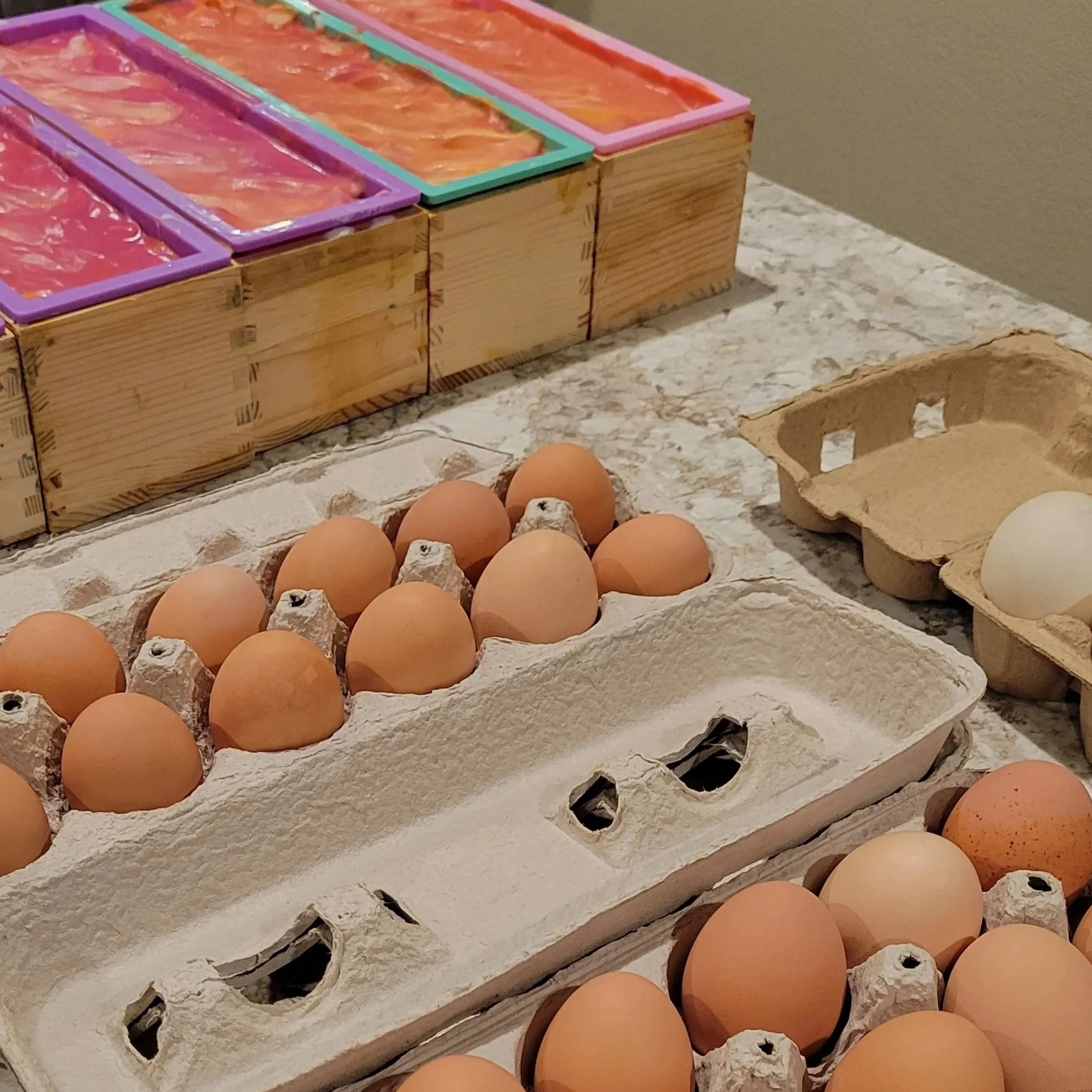
Soap cures along side eggs that are being packaged up for a sale this weekend.
Sometimes, I get stuck feeling like my farm isn’t what I want it to be — that because I don’t look like a traditional homestead, somehow what I am building is inferior.
This weekend, I attended an in-person farm finance intensive as part of an Agricultural Entrepreneurship course I’m taking through WSU. As I filled in my financial plans — listing products and prices — that familiar voice of doubt crept back in.
When I look at my numbers right now, most of the revenue flows through my handmade goods. I do have steady egg customers, and I’m regularly selling out of my current production of 10 dozen eggs per week. I have plans for a spring plant sale. Plans for produce harvest. Plans for honey. Plans for you-pick and animal encounters.
And somewhere in the back of my mind is the quiet belief that maybe then my farm will feel real.
But right now, I’m experiencing imposter syndrome for the first time.
I used to think it was a dramatic phrase. Something exaggerated. But when I attended the Eat Local First trade conference early last month, the feeling settled heavily on my shoulders.
In a speed-networking session, I described my farm over and over again to “real farmers” — people with fifty acres and full production lines. When my turn came, I felt stuck between what I dream this farm to be and what it currently is. I make artisan, value-added products. I sell eggs. I’m building toward produce.
And when someone asks, “What do you produce?” I hesitate.
Because the honest answer is: I’m still becoming.
When I look at my product list, much of the weight rests on value-added goods rather than what is harvested directly from this land. And that shadow of doubt finds its familiar resting place on my shoulder, whispering, Can you really call this a farm? Can you really call yourself a farmer?
But in those moments, I remind myself:
Today, I make soap with purchased oils. One day, those fats will come from pigs raised here. Today, I pour candles in small batches because I don’t want synthetic detergents or petroleum byproducts in my home — and if making ten candles takes the same effort as making one hundred, why not build the skill now?
This stage is not a contradiction of the dream. It is funding it.
Still, I struggle most with harvest.
The deer are relentless. Nearly ninety percent of my produce has been lost to pest damage. Last year, I stood holding the remains of tomato and pepper plants that had been in the ground for less than twelve hours — decimated overnight — and I sobbed.
Because that loss felt personal. It felt like proof that I wasn’t cut out for this.
But loss is not proof of illegitimacy. It is proof that I am learning. I adjust. I reinforce. I try again. And I hope this season is different.
So for now, I live in the in-between — where my farm leans more heavily on artisan craft than harvest, and where I sometimes feel small in rooms full of seasoned growers.
But here are the facts:
I sell out of my farm-produced goods regularly.
I have year-round expansion planned.
I apply for grants to strengthen infrastructure.
I attend agricultural trainings and financial intensives.
I track margins and reinvest intentionally.
This is not the work of a hobbyist. This is not the work of an imposter. This is what building a multi-faceted business from the ground up looks like.
My discomfort exists because my vision includes livestock, honey, on-farm experiences, and food abundance. But identity in agriculture isn’t earned at scale. It’s earned through commitment to the land and the long work of showing up.
So when that shadow of doubt feels heavy, I remind myself: I am a farmer.
Even here. Even now. Even in the in-between.